
Your needs, this model
Does it fit your priorities?
Does this model meet a manual-defrost requirement?
Yes. The exact FFUE0726A sheet identifies manual defrost; use the manual for periodic defrost and safe water handling.
Explore this need in the finder →Can it switch to a refrigerator?
The exact product page describes a refrigerator mode for the same cavity. It does not provide a separate chilled compartment while freezing; transfer frozen food elsewhere before switching and follow the supplied manual.
Explore this need in the finder →Is this a match if my room falls to 40°F?
Not under this conservative review. The exact linked guide says lower than 50°F may result in inconsistent operation and food may defrost, while the page gives lower limits of 0°F for freezer mode and 45°F for refrigerator mode. The matcher uses 50°F and keeps the conflict visible.
Explore this need in the finder →Are door-open and high-temperature alarms documented?
No. The exact family sheet does not list either alarm, so the model does not meet a requirement for both.
Explore this need in the finder →What needs measuring in a narrow room?
The spec sheet lists 21 5/16 in wide, 56 1/8 in high with hinge, 22 3/8 in deep with door and 42 in depth with door open to 90 degrees. Check exact manual clearances, outlet and delivery route too.
Explore this need in the finder →This is a document-based assessment of the exact white FFUE0726AW, not a hands-on review. I have not installed, operated, tested or measured this freezer. I compared the exact Frigidaire US product page, the model-family specification sheet and EnergyGuide, and the owner manual linked from the product page. The result is a compact upright with a real manual-defrost and conversion combination, but its minimum room-temperature evidence conflicts enough to merit care.
Small footprint, shelves instead of a chest basket
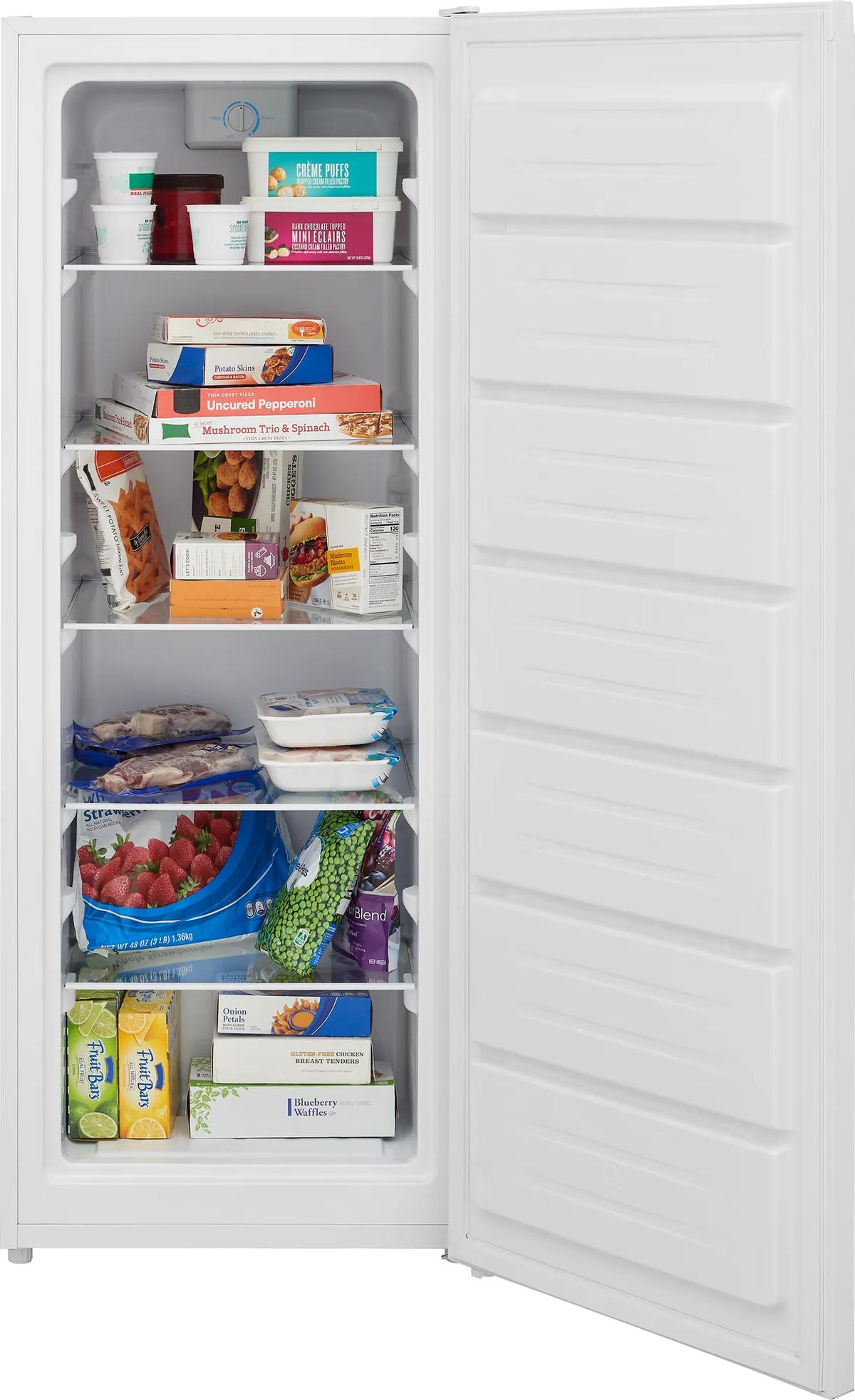
Frigidaire names this a 7-cu.-ft. upright, and the model sheet lists five adjustable glass shelves. That front-opening layout makes separate shelf levels accessible without lifting a basket from a deep chest, though every shelf still limits the height of what can be stored above it. At 21 5/16 inches wide and 56 1/8 inches high with hinge, it occupies much less width than the larger 18- to 21-cu.-ft. uprights in this reviewed set. Its listed body depth is 22 3/8 inches; the sheet gives 42 inches with the door open 90 degrees. Check both the delivery path and usable door-swing clearance.
The sheet confirms manual defrost. That is a meaningful maintenance choice, not a missing feature: the freezer will need periodic defrosting and water management. Follow the exact manual for safe defrost instructions; do not chip ice or improvise with heaters. The model is also described as convertible, so the same cavity can be switched to refrigerator mode when needed. It is not two compartments running at freezer and refrigerator temperatures simultaneously.
Conservative room floor: 50°F, not the page’s 0°F claim
The exact product page markets freezer operation from 0°F to 110°F and refrigerator operation from 45°F to 110°F. But the linked owner manual warns that ambient temperatures below 50°F may cause inconsistent operation and food may defrost. It also says that 0°F freezer and 45°F refrigerator surroundings affect operation. These claims are not reconciled in the public materials. For the finder, I use a 50°F conservative lower room boundary for both plans; this does not certify operation at that temperature, it avoids treating the manual’s warning as a positive cold-room guarantee. A garage that falls below 50°F is not an established match here. Ask Frigidaire about the exact model if the intended location approaches that limit.
Room temperature is not the cabinet’s food temperature. The manual identifies freezer and refrigerator settings, and the product page advertises garage readiness, but neither removes the need to measure the location across seasons and check food-compartment temperature with an appliance thermometer. The word “garage ready” should not be read as permission to ignore the lower-temperature warning.
Understand the energy-number difference
The US product page and specification sheet list 312 kWh per year. The linked EnergyGuide is a Canadian label for the exact FFUE0726AW and displays 296 kWh annually under its own regional labeling. Keep those records separate instead of treating them as an unexplained change or merging them into one number. Use the label attached to the specific unit and compare like-for-like regional labels; neither value is a measurement of a particular household’s electricity use.
The model sheet lists ENERGY STAR, a 15-amp minimum electrical circuit and R-600a refrigerant. The exact installation instructions require attention to clearances and a grounded supply. Measure the outlet location and path, and use the manual’s figures for the exact installation. Ask a qualified installer if the circuit is uncertain.
No documented alarms: account for that tradeoff
The product sheet does not list either a door-ajar or high-temperature alarm. This model therefore does not satisfy a requirement for both alerts. That distinction matters if the freezer will be in a remote garage, if a door may be left open, or if an outage warning is essential. A power indicator or adjustable thermostat is not equivalent to either alarm; this assessment does not add an unsupported alert feature.
For a shopper whose priorities are a narrow upright, adjustable shelves, manual defrost, and an alternate refrigerator mode, the published specification describes a distinct option in the current reviewed set. Its important compromises are the periodic defrost chore, the absence of both documented alarms, and unresolved cold-room guidance. It may be a poor choice if a sub-50°F room or automatic warning is essential.
Setup and food-transfer check
Read the exact owner manual before installation and mode changes. It warns that cold ambient conditions can affect operation and gives a 24-hour empty cooling period before loading. Move food elsewhere before switching the cavity between freezer and refrigerator use, and allow the setting to stabilize as directed. This is a single-cavity appliance, so conversion is a change in use—not a way to create simultaneous chilled and frozen storage.
The manufacturer’s exact gallery image shows the white AW freezer open with staged food. That visual is useful for recognizing the shelf configuration but does not prove that displayed packages, containers or accessories are included. Count the exact suffix on a listing and inspect its package contents before purchase. This review does not establish present availability, price, noise, independent energy consumption, reliability or customer experience.
Key specifications
Key details at a glance
| Opening style | Upright (front-opening) |
|---|---|
| Nominal capacity | 7 cu. ft. |
| Defrost system | Manual defrost |
| Automatic defrost | No |
| Frost-free design | No |
| Alternate refrigerator mode | Yes |
| Garage-ready designation | Yes |
| Lowest listed freezer-mode room temperature | 50°F |
| Highest listed freezer-mode room temperature | 110°F |
| Width | 21.31 in. |
| Height with hinge | 56.12 in. |
| Depth with door | 22.38 in. |
| Manufacturer-listed annual energy | 312 kWh/year |
| ENERGY STAR certified | Yes |
| Door-ajar alarm | No |
| High-temperature alarm | No |
| Digital temperature display | No |
| Adjustable shelves | 5 |
| Refrigerant type | R-600a |
| Minimum circuit listed | 15 A |
Use the exact model’s instructions for operating limits, supplied equipment and version differences.
Sources for this review
Sources for this assessment
Compare this freezer with your real alternatives
Use the finder to test your room, capacity and care requirements against the models that have been individually researched.