
Your needs, this model
Does it fit your priorities?
Does WFC050M6XWD meet a 5.0-cu.-ft. minimum?
Yes. Its exact specification sheet and EnergyGuide list 5.0 cu. ft.; it meets a 5.0 minimum but not 5.1. Nominal capacity is a screening field, not a guarantee that particular packages will fit.
Explore this need in the finder →What room temperature range does the review establish?
The exact product page says freezer use can function at ambient temperatures as low as 0°F. No upper room limit was found; do not use the separate -9.4°F to 8.6°F freezer-compartment range as an ambient range. The finder therefore will not confirm a warm-room maximum for this model.
Explore this need in the finder →What maintenance does manual defrost require?
The owner manual recommends defrosting two or three times a year once ice is about 3/16 inch (4 mm) thick. It calls for setting the thermostat colder in advance, unplugging, moving food to cold storage, leaving the lid open, cleaning and drying the interior, and cooling it again before reloading.
Explore this need in the finder →Does it warn about an open door and rising freezer temperature?
No combined alarm is established. The model sheet explicitly says Door-Open Alarm: No; the reviewed exact product page, sheet and manual do not document a high-temperature storage alarm. The 135-hour temperature-hold claim is not an alarm or remote monitor.
Explore this need in the finder →Can the same cavity become a refrigerator?
No refrigerator-conversion mode is documented. The exact specification table lists 0.0-cu.-ft. refrigerator capacity and 5.0-cu.-ft. freezer capacity; the refrigerator figure does not establish a convertible operating mode.
Explore this need in the finder →The Hisense WFC050M6XWD is a small, single-cavity chest freezer rather than an upright or convertible cabinet. The manufacturer’s current U.S. page, exact model sheet, energy label and owner’s manual give a useful amount of evidence for this size class, but they do not answer every placement question. This is a document-based assessment—not a hands-on test, a household energy forecast or a claim that the unit has been measured.
Compact top access with one basket
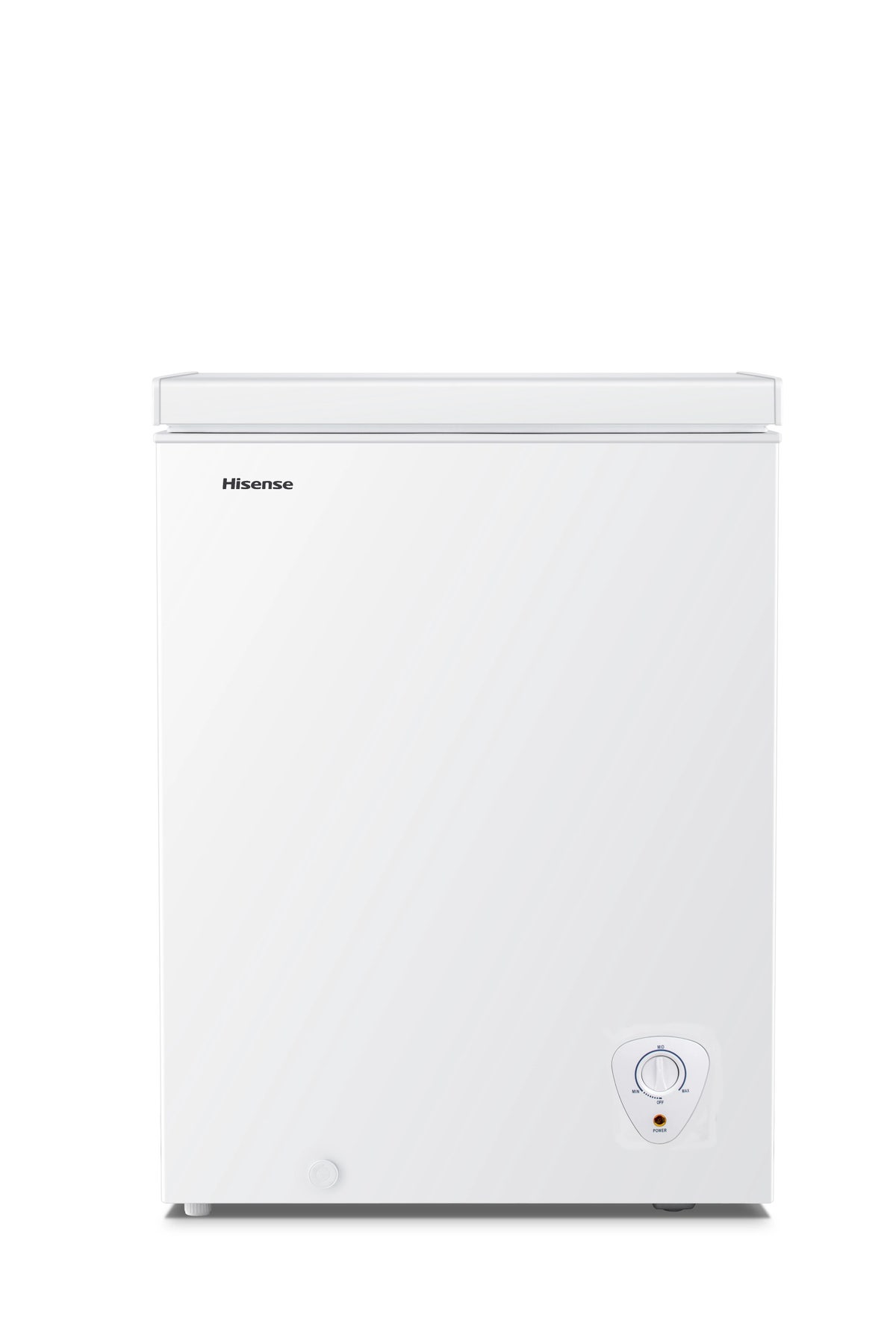
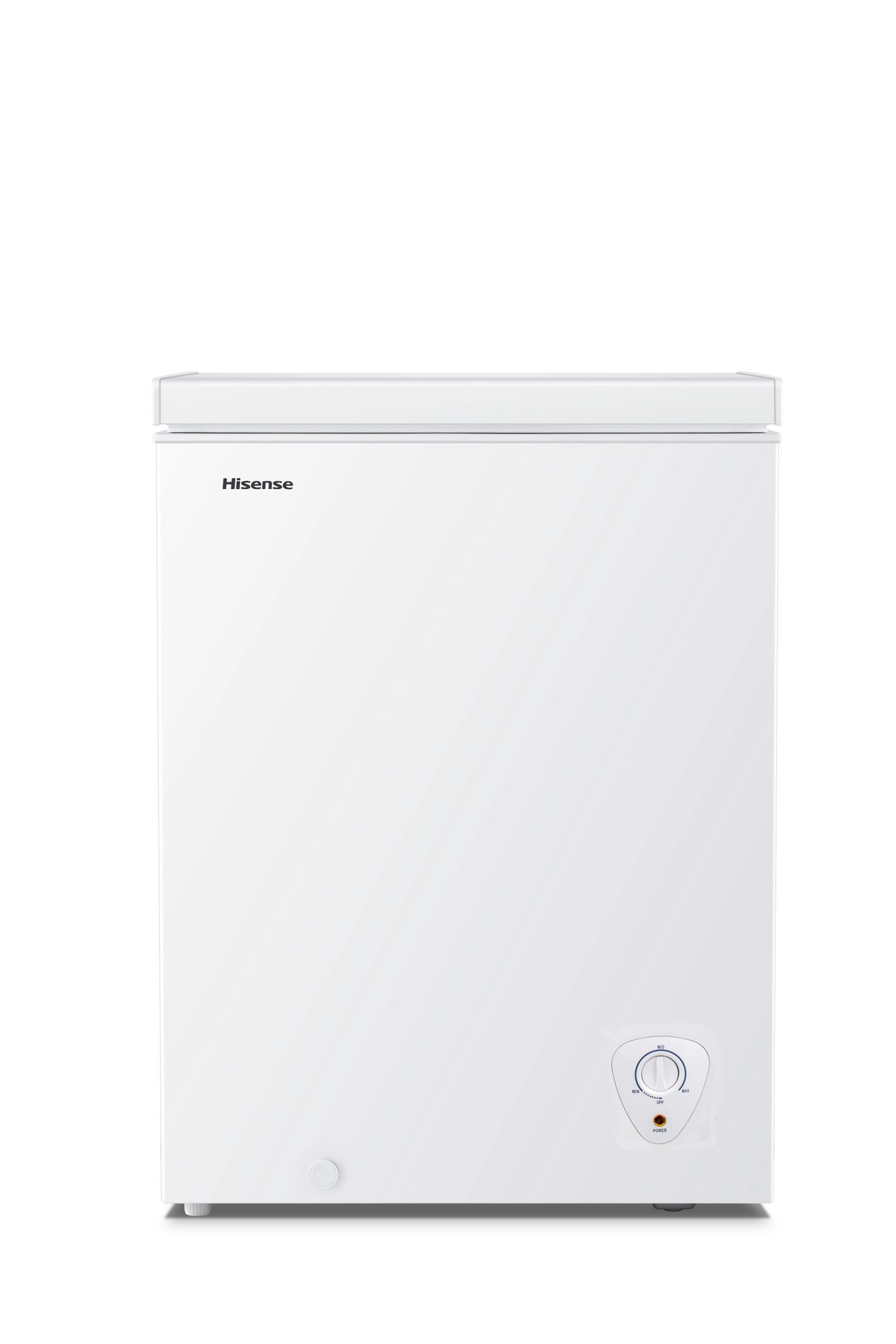
Hisense lists 5.0 cubic feet of nominal capacity, one removable wire basket and a mechanical thermostat. The top-opening layout can hold larger packages below the basket, but it also means items stored at the bottom require reaching past or lifting out that basket. A single basket is a simpler package than chest models with multiple baskets or a divider. The exact product image shows the closed cabinet and front control; it does not show the interior or prove what is included, so use the one-basket specification rather than inferring extra organizers from the photograph.
The model sheet lists a 24.6-inch width, 22.0-inch depth and 33.6-inch height. These are manufacturer dimensions, not my measurements. The shipping carton is larger at 25.8 by 22.6 by 35.0 inches, and the listed net weight is 57 pounds (66 pounds shipping weight). Check the path through doors and turns using the carton as well as the installed cabinet measurements, and allow for the lid to open above the unit. The manual calls for a level floor and stable contact on all four feet.
Manual defrost is a real maintenance job
The exact EnergyGuide labels this a manual-defrost chest; the model sheet agrees. The owner’s manual says to defrost two or three times a year when the ice layer is roughly 3/16 inch (4 mm) thick. Its procedure includes setting the thermostat colder at least 12 hours ahead, disconnecting the power, moving food to cold storage, leaving the lid open, then cleaning and drying the cavity before restarting and cooling it before loading food again. An accessible drain helps with that chore but does not make the freezer frost-free. If periodic emptying and defrosting would be difficult, an automatic-defrost upright is a different maintenance tradeoff rather than a drop-in equivalent.
The lid, basket and drain are straightforward features, but the specification lists no interior light. The mechanical dial is not a digital compartment-temperature readout. Hisense’s product copy and specification use different descriptions of the outage hold claim: the page says contents can remain below 32°F for up to 135 hours, while the sheet says it maintains 32°F for 135 hours. Treat this as a manufacturer claim, not a guaranteed duration under every load, room, door-opening pattern or outage; it is not an audible high-temperature alert or remote monitor.
Room limits and the outlet deserve a closer check
Hisense calls the model garage-ready and says it can operate at room temperatures as low as 0°F. I did not find an upper surrounding-room limit in the exact U.S. page, model sheet, EnergyGuide or manual. The sheet’s -9.4°F to 8.6°F figure is an internal freezer temperature range, not a range for the room around the appliance. The finder therefore recognizes the documented lower boundary but will not treat an unknown warm-room ceiling as proof of fit; if the garage also gets very hot, ask Hisense for the exact upper limit before relying on a match.
The owner manual requires a dedicated, grounded, single-phase 115-volt, 60-Hz outlet, direct plug-in and no extension cord or adapter. It warns that a voltage variation of 10 percent or more may affect performance. For ventilation, it calls for 4 inches at each side, 3 inches behind and more than 4 inches above; it also says to keep ventilation openings clear and not expose the appliance to rain. Measure the full setup, not just the product width, and confirm the current model manual and available outlet before delivery.
What the energy label and alarm fields do—and do not—say
The EnergyGuide linked from Hisense’s official index lists 218 kWh of estimated yearly electricity use and $26 estimated yearly cost using its stated 12-cent-per-kWh assumption. Its $16–$27 comparison band is for similar freezer models. Those numbers are label context; local utility rates, use and placement change a real bill, and neither figure is a selling price.
The sheet explicitly lists no door-open alarm, no lock/key and no interior light. I found no affirmative documentation for a high-temperature storage alarm, so that capability remains unconfirmed rather than assumed false or present. The 135-hour temperature-hold claim does not substitute for either alarm. A limited CPSC ProductName query returned an empty recall collection, but that is not a serial-number or unit-level clearance; check the exact appliance before purchase or use.
Bottom line: this is a plausible option when a 5.0-cu.-ft. chest, one wire basket and manual defrost suit the routine and the documented 0°F lower-room claim matters. It is not the right documented match for someone requiring automatic defrost, refrigerator conversion, both local alarms or a known warm-room maximum. Exact dimensions, package contents and the correct outlet and clearances should be verified against the offer and current manual.
Primary evidence reviewed: Hisense product page, exact specification sheet, owner manual and the Hisense-linked EnergyGuide.
Key specifications
Key details at a glance
| Opening style | Chest (top-opening) |
|---|---|
| Nominal capacity | 5 cu. ft. |
| Energy-label volume | 5 cu. ft. |
| Defrost system | Manual defrost |
| Automatic defrost | No |
| Frost-free design | No |
| Alternate refrigerator mode | No |
| Garage-ready designation | Yes |
| Lowest listed freezer-mode room temperature | 0°F |
| Width | 24.6 in. |
| Height with hinge | 33.6 in. |
| Depth with door | 22 in. |
| Manufacturer-listed annual energy | 218 kWh/year |
| Door-ajar alarm | No |
| Refrigerant type | R600a |
Use the exact model’s instructions for operating limits, supplied equipment and version differences.
Sources for this review
Sources for this assessment
- Hisense U.S. freezer category; prior five-card current state
- Hisense WFC050M6XWD exact U.S. product page
- Hisense exact-model support page
- Hisense WFC050M6XWD exact-model specification sheet
- Hisense official Energy Guide index listing WFC050M6XWD
- Hisense exact WFC050M6XWD U.S. EnergyGuide
- Hisense WFC050M6XWD owner operation manual
- CPSC exact ProductName=WFC050M6XWD query
- Hisense exact WFC050M6XWD product-page hero image

Compare this freezer with your real alternatives
Use the finder to test your room, capacity and care requirements against the models that have been individually researched.